


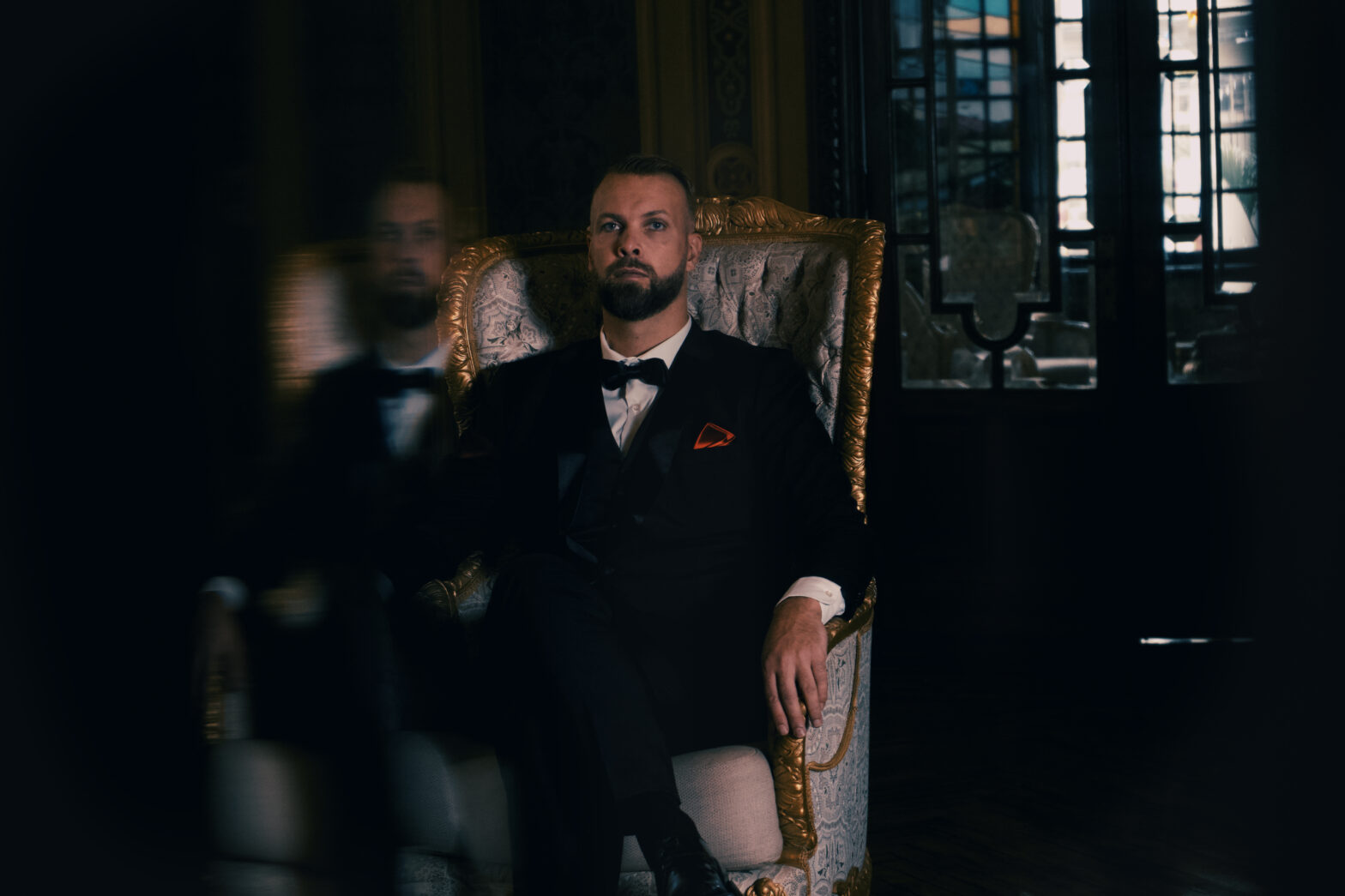
Einar Solberg second solo album Vox Occulta is a bold, heavy and symphonic statement. The album was recorded in collaboration with the much-sought-after Norwegian Radio Orchestra.
The album sees Solberg taking a deeply personal approach, having been an avid fan of classical music and soundtracks for more than 20 years. The lyrics are personal as well, and they make Vox Occulta something of a thematic follow-up to 16. Where Solberg’s solo debut revisited the death of his father and his past struggles with anxiety, this set is a warts’n’all portrait of himself and how he views the world in 2026.
Einar Solberg doesn’t like sitting still. His band, Norwegian explorers Leprous, have massively evolved over the last 15 years, from progressive metal to a distinct fusion of art rock, prog, pop and electronica. When he launched his solo career with the album 16 in 2023, he turned his back on guitar-driven rock almost entirely, delivering something as musically brave as it was lyrically introspective.
Now, the two-time recipient of Prog magazine’s Best Vocalist of the Year award has changed shape again. Vox Occulta, his second venture under his own name, is a bold, heavy and symphonic statement, recorded in collaboration with the much-sought-after Norwegian Radio Orchestra.
“16, I didn’t have any musical ambition with that album,” Solberg admits. “I was testing the waters and working with a lot of different people, because I didn’t know what my style was going to be. When I started this album, I realised, I need to sharpen my aim a bit. Who am I, and how can I exaggerate that?”
Stella Mortua, Vox Occulta’s opening track and lead single, reflects that clarity of vision. Solberg croons over classical strings, before electric guitar chords emphatically join the fray and the vocalist powers his way through a majestic chorus. From there, each song has its own character – with Medulla emphasising its huge, metallic riff and Grex being a near-12-minute odyssey – but the intent is always obvious. Solberg is out to cement himself as one of experimental music’s most epic-sounding characters.
“I want to be seen as the cinematic person in prog,” he declares. “I want to completely own that. This is a very cinematic album, and that’s what I was aiming at: to make it bigger, but also more fragile and emotional at other moments. You don’t hear the same amount of space in the music as you do in Leprous.”
It’s a deeply personal approach for Solberg, who’s been an avid fan of classical music and soundtracks for more than 20 years. The lyrics are personal as well, and they make Vox Occulta something of a thematic follow-up to 16. Where Solberg’s solo debut revisited the death of his father and his past struggles with anxiety, this set is a warts’n’all portrait of himself and how he views the world in 2026. The title track, Latin for ‘hidden voice’, is about his “worst impulses and worst feelings”.
“That voice has never been a dominant part of my personality, but it’s always been there,” Solberg explains. “I look at it with curiosity and ask, ‘Why do I have these thoughts? Why did I get super angry at this person and waste my breath on this now? Why did I pay a lot of money for this completely pointless thing right now?’ The song is dark sometimes, then suddenly it’s happy for a moment, and then it comes back down. It’s very chaotic.”
Stella Mortua is similarly dark, with Solberg singing about envy in the music industry, but there’s light amid the black. The down-tempo and piano-driven ‘Serenitas’ is about finding peace after weathering life’s hardships, and ‘Vita Fragilis’ seeks solace in the fact that everyone has to die someday.
“The fragility of life is something that I see mainly as a positive thing,” Solberg says. “It can be such a simple thing. When I’m on the tour bus in the middle of the night, I’m putting my life in the hands of whoever is driving that bus, trusting that I’ll wake up the next morning in the next city. It gives me joy to take those risks and to give up control.”
Same as 16, Vox Occulta was co-produced by Solberg and David Castillo – known for his work with Opeth, Katatonia, Amorphis and more – and Biffy Clyro alum Adam Noble handled the mixing. Drummer Keli Guðjónsson (Agent Fresco) and violinist Chris Baum (Bent Knee) return, joined by Jed Lingat on bass. Pierre Danel (Novelists) plays guitar, with contributions from John Browne (Monuments) and Ben Levin (ex-Bent Knee).
With the release of his new, heightened music, Solberg hopes to not only become the cinematic man of prog, but also continue to push his solo career until it has a legacy all of its own. For a musician with as many shades to his identity as him, one outlet isn’t enough, and there’s no telling which way each one will go next.
“This is a long-term project, and I know that I will take it where I want to have it,” Solberg says defiantly. “I know from experience how to build something, and it’s through patience and determination. What I’m hoping is for it to create two branches of fans: one that prefers Leprous and one that prefers my solo project.”